Friday, November 28, 2008

Understanding Mumbai

B787A6F5-12E8-4AD6-A1E4-623F487529F8.jpg

The world has been alight with news of the coordinated attacks against targets in Mumbai for the last two days. What has happened is despicable, and for many of us, inexplicable. This reflection in an online cricket magazine sums up what a lot of us with ties to Mumbai and India are going through:

I have watched a city of a million dreams held hostage by 20 or so men who have purged from their souls every trace of humanity - let's not confer on them the dignity of a religion - and I have felt the blood drain out of me.

I have felt a sense of paralysis and rage. My family and I are safe at home, none of my friends were in the hotels or at the other attack sites; but I am numb, not with fear or personal loss, but something far deeper: a sense of overpowering bleakness.


And of course it's not just Indians who feel this sense; we all share in the outrage and shock simply by virtue of being human.

Certainly these are terrible attacks that must be condemned and the perpetrators - including whoever financed this operation - must be brought to justice.

And a lot of us are also struggling with the question of "why?"

While it's difficult to think about at the moment, we should not be afraid to wrestle with this question, and the answers are not straightforward. One answer is that the so-called war on terror has increased the incidents of violence against civilians in the world and introduced a kind of double standard where "their" lives are not as important as "our lives". The three thousand killed in the World Trade center were the victims of terrorism, but the three thousand killed in the U.S. bombing of Afghanistan immediately thereafter were "collateral damage" in the "war on terror".

As Deepak Chopra says so eloquently in this clip, this kind of attitude leads moderates on all sides to become extremists.


52 years ago, two of the greatest thinkers the world has ever known, Albert Einstein and Bertrand Russell put this question to all of us:

Here, then, is the problem which we present to you, stark and dreadful and inescapable: Shall we put an end to the human race; or shall mankind renounce war?


So far we have been on course for the first option, the annihilation of us all. Let's hope for all our sakes we can learn the lessons that they sought to teach us and get rid of war once and for all.

If successful, we will come a lot closer to ending the insanity like that going on in Mumbai right now.

Tuesday, November 25, 2008

Old Solutions to a new crisis

Sorry for the lack of updates recently. Been busy with the whole fall of global capitalism thingy. For some glimpses at what we've been up to check here and here.

Recent developments are almost too overwhelming to even comment about. A couple of scattered thoughts:

1) The IMF needs to go. A new loan to Pakistan was approved today, and loans to Hungary and Ukraine have already gone through. The IMF is using this crisis to salvage its reputation and its balance sheet, when it is the institution that created the preconditions for the crisis in the first place. Here's a more detailed article that Sameer wrote on this subject.

2) Let's hope Obama's policies are more visionary than his choices for important economic advisors. Democracy Now had a good panel on this this morning. Basically, almost all of Obama's economic team are former Clinton-era officials who are as responsible for the current situation as anyone. Well anyone except Alan Greenspan, who's in a category of his own. The New York Times, which is normally pretty bad on all this, has a great editorial explaining the culpability of Geithner, Summers, Rubin and all the rest. Nate Silver, who proved himself to be a brilliant pollster this election cycle, has an article arguing that we shouldn't be too quick to judge Obama by his cabinet, as most of the decisions will be coming from the top down. Somehow I don't find that thought comforting, though the chart of policies Nate prepared for that article is helpful.

In general we need to push Obama and his team towards a new kind of economic policy, one that will set up institutions that are more transparent, more accountable and more democratic than what we have now. Ultimately the system should be one that prioritizes human need and basic human rights over the "right" to unlimited profit. This crisis presents all of us who would work for change the opportunity to make those changes real. The opportunity won't come again in most of our lifetimes (the last time was in the 1930s and 40s), so we'd better make the most of it for ourselves and for the next generation.

Tuesday, November 11, 2008

Out of Afghanistan

While I'm as teary as anybody else about the events of last Tuesday, I'm also pretty uncertain about whether or not President Barack Obama will put an end to U.S. empire.

Doing so would not only be a good thing in and of itself - ending empire is the only way to ensure the safety of U.S. citizens around the world. It's the only path to peace we have.

While I hope that Obama will be a different kind of president, it's up to all of us to help him along the way. As a Muslim who's been fighting Muslim fundamentalism a lot longer than George W. Bush, it's particularly painful for me to see the Taliban legitimized by the ongoing U.S. occupation. This article - which is in part an attempt to ask the question of how someone like Martin Luther King would treat the Afghanistan situation - is also available here.

The ultimate weakness of violence is that it is a descending spiral, begetting the very thing it seeks to destroy. Instead of diminishing evil, it multiplies it. Through violence you may murder the liar, but you cannot murder the lie, nor establish the truth. Through violence you may murder the hater, but you do not murder hate. In fact, violence merely increases hate. So it goes. Returning violence for violence multiplies violence, adding deeper darkness to a night already devoid of stars. Darkness cannot drive out darkness: only light can do that. Hate cannot drive out hate: only love can do that.

-
Dr. Martin Luther King, Jr.


I want justice. And there's an old poster out West, I recall, that says, "Wanted: Dead or Alive".

-
George W. Bush


In recent history, two concepts of justice have stood out. Dr. Martin Luther King, Jr., believed in a kind of justice that could only be achieved when systematic oppression had been eliminated from the world. Along the way, people would have to be held accountable for their crimes. Those who had done wrong would have to admit that they had done wrong and pay some appropriate restitution for their crimes, as happened decades later in South Africa's truth and reconciliation commissions. But justice was forever intertwined with a changing of the human spirit for Dr. King. It was the societal uplifting of love over hate, of human dignity over human debasement. It was a coming to terms with our violent history and affirming values of love and compassion over those of hate and retribution.


George W. Bush, on the other hand, believed in the justice of old Western movies and gunfights.


When he inherits the Bush legacy on January 21st, 2009, Barack Obama will have to choose between these two approaches. The decision he makes will reverberate around the world and be one of the first indicators of whether "Change We Can Believe In" was merely good sloganeering.


Ending Bush's imperial misadventures in Iraq will certainly be a top priority for the incoming administration, but Obama will also be tested in Afghanistan. His words so far — calling Afghanistan the "central front" in the "War on Terror" and demanding more military action against insurgents allied with the Taliban — don't inspire confidence that he would chose the King doctrine over the Bush doctrine.


Reckless Interventions

In 1996, the Taliban, a faction of the anti-Soviet Mujahideen with fundamentalist Wahabi Muslim beliefs, took control of Kabul and most of Afghanistan. Zbigniew Brzezinski, Jimmy Carter's National Security Advisor, supported the Mujahideen (who from the very beginning had fundamentalist tendencies) as part of the "Afghan trap" which succeeded in fatally wounding the Soviet empire. While many Afghans greeted the Taliban's rise to power with delight, their theocratic government soon began to grate on the people of Afghanistan, for whom fundamentalist Islam was almost as foreign as Mormonism.


After the events of September 11, 2001, the Bush administration portrayed the Taliban as deeply connected with al-Qaeda, the terrorist network that claimed responsibility for the attacks, and therefore argued for going to war against Afghanistan. When the Taliban countered that they were happy to give up Osama bin Laden, the alleged mastermind of the 9/11 attacks, if the U.S. could produce any evidence for the allegation, the U.S. scoffed. Then the U.S. invaded.


The invasion succeeded in two things: First, it brought down a terrible fundamentalist regime while taking an inordinately heavy toll in civilian causalities. The Taliban had instituted a brutal form of shariah law and forced minorities to wear identification tags. They had even destroyed ancient Buddhist carvings claiming that the depiction of the human form is "unislamic." Many Afghans — particularly the half of the population who happen to be women — were excited to see the Taliban ousted. While this is an accomplishment, it's worth remembering that expectations for improvement in women's lives were largely unmet.


The second and even more dangerous accomplishment of the U.S. invasion of Afghanistan was to elevate the Taliban, al-Qaeda and anyone willing to resist U.S. aggression to the status of heroes or freedom fighters.


Perhaps the easiest way to understand what most Afghans and many South Asians, Muslims, and others around the world felt after the invasion is to remember how Americans felt after the September 11 attacks. George W. Bush was a deeply unpopular president. The election that brought him to power had split the population, with shady dealings in Florida and an activist Supreme Court ultimately deciding the race in favor of Bush. Many of my liberal compatriots despised the president, who was already acquiring a reputation for spending his presidency on vacation.


But after the 9/11 attacks, those same liberals were rallying around Bush. The logic was simple: in a time of crisis, with your country under attack, you support those who are going to defend you. You may not like George W. Bush, but his policies his armed forces stand between you and whoever caused significant damage to New York and Washington, DC.


By the same logic, who stood between Afghan civilians and the NATO aerial bombardments that killed about 3,000 people? The Taliban. Every bomb that detonated on a wedding party led to tens, perhaps hundreds of young people — mostly young boys and many of them orphans — joining the resistance movement under the flag of the Taliban.


And it's not just that the Afghan population believes that the Taliban resistance is legitimate; that resistance is legitimate under international law. No less important a document than the United Nations charter gives the Taliban and other Afghans the right to legitimate self-defense against U.S. aggression.


The Real War against Fundamentalism

So if aerial bombardments and occupations give legitimacy to those very fundamentalists who Afghans would remove from power, what does the real war on fundamentalism look like?


In 1999 I was the first staff person of the International Network for the Rights of Female Victims of Violence in Pakistan, a group that was combating "honor crimes" along the Pakistan-Afghanistan border. These were incidences of domestic violence, often against a wife, a sister, a daughter or even a mother who was accused of having some kind of illicit sexual relationship. We understood that these crimes were on the rise because of the spread of Taliban-style Wahabi Islam into tribal areas that already had an extremely patriarchal view of women's bodies.


What was our weapon of choice in fighting against the Talibanization of what has traditionally been a tolerant, ecumenical form of Islam? Education. We taught women their rights under Pakistani and Afghani law, we taught about the passages in the Quran that mentioned women's rights, and we also tried to educate people about other traditions — whether they be secular humanist traditions or the Hindu and Christian traditions of neighboring countries and tribes. In other words we tried to undermine the hatred, the xenophobia, the fear upon which fundamentalism is built.


Such efforts may take generations, and they almost always require the state to play a role in education, development and ensuring employment for all. But ultimately education is the only way to combat religious fundamentalism, just as negotiation is ultimately the only way to end war.


Buying into a Failed Solution

While Obama's election may indicate a shift in U.S. foreign policy (and hopefully a rejection of the Bush doctrine of pre-emptive war), Obama has prescribed more military operations in Afghanistan.


For more than a year, Obama has argued for redeploying U.S. troops from Iraq to Afghanistan. He has called Afghanistan the "central front in the War on Terror" and has even threatened to bomb Pakistan should there be evidence that Afghan warlords are hiding there and the Pakistani government isn't "doing enough" about it. (On this last point, Bush has already bombed Pakistan several times over the last few months, prompting the Pakistani government to publicly rebuke the U.S. for violating its sovereignty.)


While Obama's rhetoric in arguing for increased involvement in Afghanistan makes some sense — he claims that Bush has been so involved with Iraq that the al-Qaeda leaders who allegedly orchestrated the September 11 attacks are still at large — his proposed methodology doesn't.


Instead of scaling up an already disastrous war, the United States could change course in a way that would ultimately do a lot more to ensure the world's safety. Such measures should include:


  1. Withdrawing troops. International law is clear on this subject. No country may occupy another indefinitely and certainly not without the will of the people being occupied. If an Obama administration truly thinks that withdrawing U.S. and NATO troops would be a bad thing for Afghans, hold a referendum to see who would like the troops to remain.

  2. Working with the various Afghan factions to begin negotiations. Wars are rarely stopped on the battlefield, and those that are have a tendency to break out again after a few years. The recent history of Afghanistan illustrates this point. It's better by far for enemies and friends, Pashtun, Tajik, and others to settle differences through negotiation based on mutual respect and the rule of law.

  3. Once stability and security are guaranteed in Afghanistan, beginning the attack on fundamentalism in earnest. Working to incorporate Afghanistan into the international human rights framework through enforcing UN measures which Afghanistan has already ratified, such as the Convention on the Elimination of All Forms of Discrimination against Women is one step that can be taken in this regard. Another is major investment in social infrastructure and particularly health and education measures which will ultimately help Afghanistan recover from being bombed "into the stone age."


If the idea of immediately stopping all military operations in Afghanistan sounds radical, it shouldn't. No less than President Hamid Karzai pleaded for an end to the bombings immediately after the U.S. election, as yet another wedding party fell victim to bombs from the sky.


For the sake of all us, Afghan and American, let's hope President Barack Obama heeds his call.

Saturday, November 8, 2008

Speechless

Although all the math had been pointing to an overwhelming Obama victory for months, we were speechless Tuesday night when it actually happened. With this election, the U.S. public has rejected the descent into fascism orchestrated by George W. Bush and Karl Rove.

Does this mean that all the evils of racism, classism, and sexism are solved? Of course not.

But Obama's message of making democracy more participatory, his acceptance speech and the establishment of the change.gov website where ordinary folks can provide input into policy decisions are all promising signs. And the fact that we have a half-Kenyan, half white American man in the oval office exactly 40 years after the assassination of Martin Luther King should be cause for joy and celebration.

The Jed report has put together this montage which captures the spirit of that evening for those who want to relive it. My favorite are the Fox news clips...

Thursday, October 30, 2008

Christians Worship Golden Calf

Geez, I don't know how to satirize this. Evangelicals really don't read the Bible, do they?

Courtesy wonkette:

ADD51996-93F5-4505-B258-F3C7660E648B.jpg


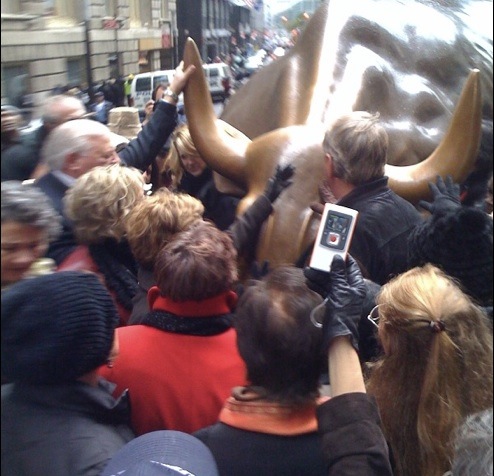
Did you know that some Christian dingbat has dubbed today the “Day of Prayer for the World’s Economies?” Well here they are, at the Wall Street bull statue thing, praying to Jesus for money. The dingbat has explained, “We are going to intercede at the site of the statue of the bull on Wall Street to ask God to begin a shift from the bull and bear markets to what we feel will be the ‘Lion’s Market,’ or God’s control over the economic systems.”

Wednesday, October 29, 2008

McCain rallies getting uglier

As if we needed more evidence that the McCain-Palin ticket's last ditch efforts to win this election involve pandering to the racists and bigots that make up much of the republican base, 538.com has this report:
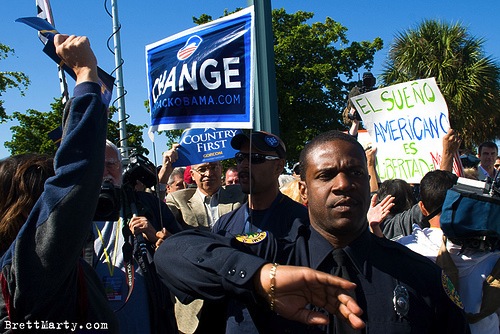
[After a McCain rally in Miami, Fl] we witnessed a near-street riot involving the exiting McCain crowd and two Cuban-American Obama supporters. Tony Garcia, 63, and Raul Sorando, 31, were suddenly surrounded by an angry mob. There is a moment in a crowd when something goes from mere yelling to a feeling of danger, and that's what we witnessed. As photographers and police raced to the scene, the crowd elevated from stable to fast-moving scrum, and the two men were surrounded on all sides as we raced to the circle.

47C5AEEA-EEEA-455B-B5F5-FDC9F59260C8.jpg


"People were screaming 'Terrorist!' 'Communist!' 'Socialist!'" Sorando said when we caught up with him. "I had a guy tell me he was gonna kill me."

Asked what had precipitated the event, "We were just chanting 'Obama!' and holding our signs. That was it. And the crowd suddenly got crazy."


Charming. I still believe that this election and the economic downturn really mark the beginning of the end of the Republican party, but that could just be wishful thinking on my part. I can only hope that the vast majority of U.S. citizens run away from a party that encourages (or at least does not publicly denounce) racism.

Here's Keith Olbermann on McCain's failure to denounce the race baiting incident that went on in Pennsylvania over the weekend:


Thursday, October 23, 2008

Eric Mann on turning out for Obama

Eric Mann at the Los Angeles Strategy Center has this brilliant, but somewhat lengthy article on why progressives should support Obama. For someone who traditionally sees the Democratic party as the lesser of two evils, this has been a question I've been wrestling with (and obviously Mann has given this a lot of thought).

I won't post all ten reasons to support Obama here (but I do suggest you check out the whole article) but here's an excerpt of what I think is the most compelling reason to vote for Obama, especially if you're in a Swing state. (If you're not in a swing state, or even if you are, you could also check out vote pacts, a guilt-free way to support third party candidates.)

6) Because the McCain campaign is an attack on the Left.

The McCain campaign wants to kill the Left in the U.S. and internationally, kill social security, the social safety net, and anything “social” including even the hope of social-ism. Obama is being attacked as an enemy because he is Black and because he is a moderate liberal. The attack on the Left broadly defined must be met by a counter-attack against McCain and for Obama in the last two weeks of this campaign.

Look at McCain’s targets:

* William Ayers, billed a “terrorist” by the McCain camp, worked against the war in Vietnam in which four million people were killed. Ayers is a symbol of the anti-war movement and its most militant wing.

* Reverend Wright. Reverend Wright is a respected theologian whose “crime” was saying that racism is “endemic” to the United States and that the U.S. sees the world through the eyes of an empire.

* ACORN is being attacked by the McCain campaign for registering Democratic-leaning voters. ACORN may have gotten some bad names in the voter registration process but none of those people could vote or be counted. By contrast, the Republicans prevent people from voting who are registered to vote, deny valid signatures and voters, and close down polling places in Black and heavily Democratic districts. They defy the electoral process and have stolen state and national elections.

* Socialism. McCain has begun attacking as “socialist” Obama’s efforts to make income taxes more progressive and to use some of the wealth to help the poor. McCain said, “At least in Europe the Socialist leaders who so admire my opponent are upfront about their objectives. They use real numbers and honest language.” McCain proposes cutting capital gains taxes and giving more subsidies to the rich.

Obama’s ties to Ayers were minimal and nothing to apologize for. His ties to Reverend Wright were profound and his disassociation from his mentor deplorable. Obama’s distancing himself from ACORN reflects weakness. But, as Reverend Wright pointed out, Obama is a politician running for office; he makes his tactical moves according to his strategic aim of getting elected. I wish that Obama would defend socialism but he is not a socialist and if he were, he would not be the Democratic nominee for president.

Whether or not Obama chooses to disassociate, denounce, or distance himself from the anti-Vietnam war movement, from the rhetoric and analyses of the Civil Rights and Black Liberation Movements, from grassroots voter registration, and from socialism—those of us on the Left have our own interests in this election that include but also go beyond Obama’s objectives.

Whether Obama chooses to identify with or to renounce these connections, we on the Left need to grasp that these attacks from McCain are against us, not just Obama. If McCain is elected, what do we think he will do to those of us who fought against the war in Vietnam and are fighting to end the U.S. occupation of Iraq ? What will he do to those who will continue to speak and act against the endemic racism of the United States , or to those of us who would study and advocate socialist alternatives to capitalism? I fear for those on the Left who do not see the writing on the wall.

Let’s turn out the vote for Barack Obama, Now.


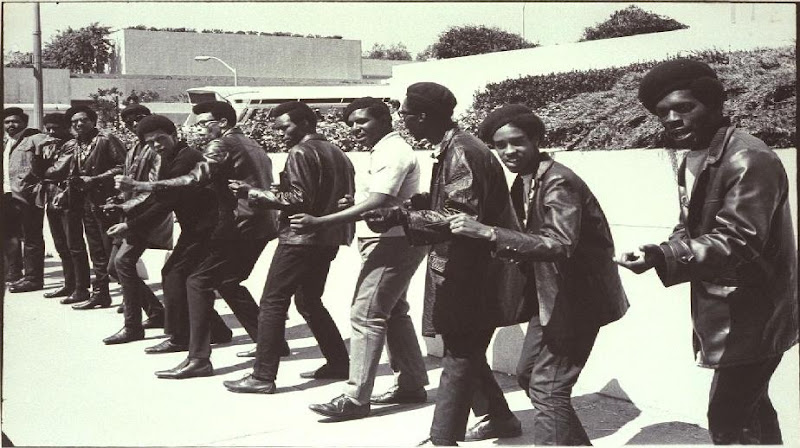
And a little reminder of what those more militant days looked like:

642620A3-4C52-43A5-A191-6ABA08BA7B92.jpg

There was dancing at the revolution...