Showing posts with label war of terror. Show all posts

Saturday, January 17, 2009

Chomsky on Colonialism and Gaza

05AEFD03-AEE6-4206-81B6-9C640CB57A73.jpg
Photo: AP


A couple days ago I had the opportunity to do an interview with Noam Chomsky. The bulk of the interview was on the economic crisis, but I would have felt guilty not asking him about Gaza given what's going on.

The whole interview is definitely worth reading (like everything Chomsky does) but this line particularly struck me:

I think one of the reasons for popular support for [the Israeli occupation and military offensives] in the United States is that it resonates very well with American history. How did the United States get established? The themes are similar.


Colonialism looks very similar no matter where it occurs. How similar are the ideas of "manifest destiny", which basically said that all land between the Atlantic and Pacific oceans belonged to European settlers, and the zionist notion that the land between the Jordan River and the Red sea belongs to Jews?

And of course the really striking thing is what kind of blinders folks in the U.S., Israel, and mainstream media all over the world have to be wearing to not be able to see that. As a friend of mine commented yesterday, if a thousand trees were cut down in a forest, there would be outrage. If a thousand animals were killed in a zoo there would be disgust. A thousand Palestinians - eh, that's ok, I guess. Very disturbing.

Friday, November 28, 2008

Understanding Mumbai

B787A6F5-12E8-4AD6-A1E4-623F487529F8.jpg

The world has been alight with news of the coordinated attacks against targets in Mumbai for the last two days. What has happened is despicable, and for many of us, inexplicable. This reflection in an online cricket magazine sums up what a lot of us with ties to Mumbai and India are going through:

I have watched a city of a million dreams held hostage by 20 or so men who have purged from their souls every trace of humanity - let's not confer on them the dignity of a religion - and I have felt the blood drain out of me.

I have felt a sense of paralysis and rage. My family and I are safe at home, none of my friends were in the hotels or at the other attack sites; but I am numb, not with fear or personal loss, but something far deeper: a sense of overpowering bleakness.


And of course it's not just Indians who feel this sense; we all share in the outrage and shock simply by virtue of being human.

Certainly these are terrible attacks that must be condemned and the perpetrators - including whoever financed this operation - must be brought to justice.

And a lot of us are also struggling with the question of "why?"

While it's difficult to think about at the moment, we should not be afraid to wrestle with this question, and the answers are not straightforward. One answer is that the so-called war on terror has increased the incidents of violence against civilians in the world and introduced a kind of double standard where "their" lives are not as important as "our lives". The three thousand killed in the World Trade center were the victims of terrorism, but the three thousand killed in the U.S. bombing of Afghanistan immediately thereafter were "collateral damage" in the "war on terror".

As Deepak Chopra says so eloquently in this clip, this kind of attitude leads moderates on all sides to become extremists.


52 years ago, two of the greatest thinkers the world has ever known, Albert Einstein and Bertrand Russell put this question to all of us:

Here, then, is the problem which we present to you, stark and dreadful and inescapable: Shall we put an end to the human race; or shall mankind renounce war?


So far we have been on course for the first option, the annihilation of us all. Let's hope for all our sakes we can learn the lessons that they sought to teach us and get rid of war once and for all.

If successful, we will come a lot closer to ending the insanity like that going on in Mumbai right now.

Tuesday, November 11, 2008

Out of Afghanistan

While I'm as teary as anybody else about the events of last Tuesday, I'm also pretty uncertain about whether or not President Barack Obama will put an end to U.S. empire.

Doing so would not only be a good thing in and of itself - ending empire is the only way to ensure the safety of U.S. citizens around the world. It's the only path to peace we have.

While I hope that Obama will be a different kind of president, it's up to all of us to help him along the way. As a Muslim who's been fighting Muslim fundamentalism a lot longer than George W. Bush, it's particularly painful for me to see the Taliban legitimized by the ongoing U.S. occupation. This article - which is in part an attempt to ask the question of how someone like Martin Luther King would treat the Afghanistan situation - is also available here.

The ultimate weakness of violence is that it is a descending spiral, begetting the very thing it seeks to destroy. Instead of diminishing evil, it multiplies it. Through violence you may murder the liar, but you cannot murder the lie, nor establish the truth. Through violence you may murder the hater, but you do not murder hate. In fact, violence merely increases hate. So it goes. Returning violence for violence multiplies violence, adding deeper darkness to a night already devoid of stars. Darkness cannot drive out darkness: only light can do that. Hate cannot drive out hate: only love can do that.

-
Dr. Martin Luther King, Jr.


I want justice. And there's an old poster out West, I recall, that says, "Wanted: Dead or Alive".

-
George W. Bush


In recent history, two concepts of justice have stood out. Dr. Martin Luther King, Jr., believed in a kind of justice that could only be achieved when systematic oppression had been eliminated from the world. Along the way, people would have to be held accountable for their crimes. Those who had done wrong would have to admit that they had done wrong and pay some appropriate restitution for their crimes, as happened decades later in South Africa's truth and reconciliation commissions. But justice was forever intertwined with a changing of the human spirit for Dr. King. It was the societal uplifting of love over hate, of human dignity over human debasement. It was a coming to terms with our violent history and affirming values of love and compassion over those of hate and retribution.


George W. Bush, on the other hand, believed in the justice of old Western movies and gunfights.


When he inherits the Bush legacy on January 21st, 2009, Barack Obama will have to choose between these two approaches. The decision he makes will reverberate around the world and be one of the first indicators of whether "Change We Can Believe In" was merely good sloganeering.


Ending Bush's imperial misadventures in Iraq will certainly be a top priority for the incoming administration, but Obama will also be tested in Afghanistan. His words so far — calling Afghanistan the "central front" in the "War on Terror" and demanding more military action against insurgents allied with the Taliban — don't inspire confidence that he would chose the King doctrine over the Bush doctrine.


Reckless Interventions

In 1996, the Taliban, a faction of the anti-Soviet Mujahideen with fundamentalist Wahabi Muslim beliefs, took control of Kabul and most of Afghanistan. Zbigniew Brzezinski, Jimmy Carter's National Security Advisor, supported the Mujahideen (who from the very beginning had fundamentalist tendencies) as part of the "Afghan trap" which succeeded in fatally wounding the Soviet empire. While many Afghans greeted the Taliban's rise to power with delight, their theocratic government soon began to grate on the people of Afghanistan, for whom fundamentalist Islam was almost as foreign as Mormonism.


After the events of September 11, 2001, the Bush administration portrayed the Taliban as deeply connected with al-Qaeda, the terrorist network that claimed responsibility for the attacks, and therefore argued for going to war against Afghanistan. When the Taliban countered that they were happy to give up Osama bin Laden, the alleged mastermind of the 9/11 attacks, if the U.S. could produce any evidence for the allegation, the U.S. scoffed. Then the U.S. invaded.


The invasion succeeded in two things: First, it brought down a terrible fundamentalist regime while taking an inordinately heavy toll in civilian causalities. The Taliban had instituted a brutal form of shariah law and forced minorities to wear identification tags. They had even destroyed ancient Buddhist carvings claiming that the depiction of the human form is "unislamic." Many Afghans — particularly the half of the population who happen to be women — were excited to see the Taliban ousted. While this is an accomplishment, it's worth remembering that expectations for improvement in women's lives were largely unmet.


The second and even more dangerous accomplishment of the U.S. invasion of Afghanistan was to elevate the Taliban, al-Qaeda and anyone willing to resist U.S. aggression to the status of heroes or freedom fighters.


Perhaps the easiest way to understand what most Afghans and many South Asians, Muslims, and others around the world felt after the invasion is to remember how Americans felt after the September 11 attacks. George W. Bush was a deeply unpopular president. The election that brought him to power had split the population, with shady dealings in Florida and an activist Supreme Court ultimately deciding the race in favor of Bush. Many of my liberal compatriots despised the president, who was already acquiring a reputation for spending his presidency on vacation.


But after the 9/11 attacks, those same liberals were rallying around Bush. The logic was simple: in a time of crisis, with your country under attack, you support those who are going to defend you. You may not like George W. Bush, but his policies his armed forces stand between you and whoever caused significant damage to New York and Washington, DC.


By the same logic, who stood between Afghan civilians and the NATO aerial bombardments that killed about 3,000 people? The Taliban. Every bomb that detonated on a wedding party led to tens, perhaps hundreds of young people — mostly young boys and many of them orphans — joining the resistance movement under the flag of the Taliban.


And it's not just that the Afghan population believes that the Taliban resistance is legitimate; that resistance is legitimate under international law. No less important a document than the United Nations charter gives the Taliban and other Afghans the right to legitimate self-defense against U.S. aggression.


The Real War against Fundamentalism

So if aerial bombardments and occupations give legitimacy to those very fundamentalists who Afghans would remove from power, what does the real war on fundamentalism look like?


In 1999 I was the first staff person of the International Network for the Rights of Female Victims of Violence in Pakistan, a group that was combating "honor crimes" along the Pakistan-Afghanistan border. These were incidences of domestic violence, often against a wife, a sister, a daughter or even a mother who was accused of having some kind of illicit sexual relationship. We understood that these crimes were on the rise because of the spread of Taliban-style Wahabi Islam into tribal areas that already had an extremely patriarchal view of women's bodies.


What was our weapon of choice in fighting against the Talibanization of what has traditionally been a tolerant, ecumenical form of Islam? Education. We taught women their rights under Pakistani and Afghani law, we taught about the passages in the Quran that mentioned women's rights, and we also tried to educate people about other traditions — whether they be secular humanist traditions or the Hindu and Christian traditions of neighboring countries and tribes. In other words we tried to undermine the hatred, the xenophobia, the fear upon which fundamentalism is built.


Such efforts may take generations, and they almost always require the state to play a role in education, development and ensuring employment for all. But ultimately education is the only way to combat religious fundamentalism, just as negotiation is ultimately the only way to end war.


Buying into a Failed Solution

While Obama's election may indicate a shift in U.S. foreign policy (and hopefully a rejection of the Bush doctrine of pre-emptive war), Obama has prescribed more military operations in Afghanistan.


For more than a year, Obama has argued for redeploying U.S. troops from Iraq to Afghanistan. He has called Afghanistan the "central front in the War on Terror" and has even threatened to bomb Pakistan should there be evidence that Afghan warlords are hiding there and the Pakistani government isn't "doing enough" about it. (On this last point, Bush has already bombed Pakistan several times over the last few months, prompting the Pakistani government to publicly rebuke the U.S. for violating its sovereignty.)


While Obama's rhetoric in arguing for increased involvement in Afghanistan makes some sense — he claims that Bush has been so involved with Iraq that the al-Qaeda leaders who allegedly orchestrated the September 11 attacks are still at large — his proposed methodology doesn't.


Instead of scaling up an already disastrous war, the United States could change course in a way that would ultimately do a lot more to ensure the world's safety. Such measures should include:


  1. Withdrawing troops. International law is clear on this subject. No country may occupy another indefinitely and certainly not without the will of the people being occupied. If an Obama administration truly thinks that withdrawing U.S. and NATO troops would be a bad thing for Afghans, hold a referendum to see who would like the troops to remain.

  2. Working with the various Afghan factions to begin negotiations. Wars are rarely stopped on the battlefield, and those that are have a tendency to break out again after a few years. The recent history of Afghanistan illustrates this point. It's better by far for enemies and friends, Pashtun, Tajik, and others to settle differences through negotiation based on mutual respect and the rule of law.

  3. Once stability and security are guaranteed in Afghanistan, beginning the attack on fundamentalism in earnest. Working to incorporate Afghanistan into the international human rights framework through enforcing UN measures which Afghanistan has already ratified, such as the Convention on the Elimination of All Forms of Discrimination against Women is one step that can be taken in this regard. Another is major investment in social infrastructure and particularly health and education measures which will ultimately help Afghanistan recover from being bombed "into the stone age."


If the idea of immediately stopping all military operations in Afghanistan sounds radical, it shouldn't. No less than President Hamid Karzai pleaded for an end to the bombings immediately after the U.S. election, as yet another wedding party fell victim to bombs from the sky.


For the sake of all us, Afghan and American, let's hope President Barack Obama heeds his call.

Friday, August 29, 2008

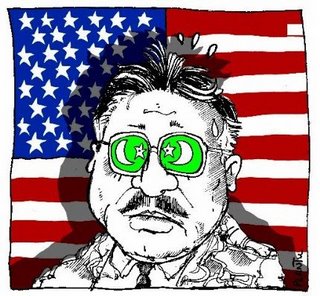
Understanding Musharraf: the U.S. and Pakistan

Here's a short piece that I had intended to try to publish in the mainstream. I think the coverage of the democratic convention kind of squashed it... H/t to Emily at Foreign Policy in Focus for doing an edit on this.

le_monde_musharraf_cartoon.jpg

Understanding Musharraf
What the U.S. needs to know about Pakistan's recent past and immediate future
Sameer Dossani

In September 2001, Pervez Musharraf had a choice. He could either fulfill his promises made to the Pakistani people (to hold an election in early 2002 and resign as president) or he could bow to U.S. pressure to cancel those plans entirely and allow Pakistan to serve as a lynchpin for an upcoming U.S. invasion of Afghanistan. If any democratic principles were to be invoked, there’s no doubt what the Pakistani people would have chosen. They had no interest in getting involved in a U.S. war against their neighbor. Instead of following the will of the Pakistani people and following through on his commitments, Musharraf chose to embrace the U.S. agenda.

Now that he has announced his resignation seven years later, Musharraf’s decision to side with U.S. interests against the interests of his own people remains the central moment of his leadership. Defenders of his legacy may say that given the dire events of September 11, 2001 and the strong role that the United States has played in Pakistan since the 1970s Musharraf had little choice. Detractors may retort that regardless of the limited options, it was unconscionable to invest resources in a U.S. war when Pakistan clocks in at 136th place out of 177 countries in the Human Development Index of the United Nations Development Program. The country needs to spend its limited resources instead on basic infrastructure, education services, and healthcare.

These points of view ignore a basic fact – whether Musharraf's actions were right or wrong, they took the country further away from democracy. No one believes that the Pakistani public would have supported the war against the Taliban - an AC Nielsen poll conducted in December 2001 showed only 9% support for the U.S. action in Afghanistan. In order to act in line with U.S. interests, Masharraf was playing the part of the totalitarian dictator. He overrode existing safeguards – by consolidating his power as head of all branches of the armed services, for example – to ensure that his wishes were obeyed. For his heavy-handed actions he was richly praised in the U.S. media and elsewhere. It wasn’t until he repeated that heavy-handedness in 2007, when Musharraf suspended the constitution as well as several senior judges in order to ensure his smooth transition to civilian rule, that anyone in the West began to criticize him.

Musharraf's story gives the lie to the claim that the Bush's agenda in the Muslim world was one of "democratization." If Musharraf had followed the will of his people in 2001, the United States may have taken measures to remove him from office in addition to waging war against the Taliban, so important was Pakistan as the frontline in the “War on Terror”.

As Bush's tenure draws to a close, leaving a legacy that includes a failed foreign policy, this is a good time to evaluate the nation’s relationship with Pakistan and to seek a new course. Pakistan's current leaders have spoken out in favor of negotiating with tribal leaders allied with the Taliban instead of seeking to drop bombs on them - bombs that don’t discriminate between soldier and civilian. If they are sincere in their efforts, they have a chance at ending the cycle of violence that has plagued the region for decades. Since the assassination of Benazir Bhutto, both of Pakistan’s mainstream political parties enjoy mass support in a completely new way. For us in the United States, the best way we can show our support for the struggling Pakistani state and any hope it has at democracy is to get out of the way.

Sameer Dossani is a Pakistani-American, a Foreign Policy In Focus contributor, and director of 50 Years Is Enough: U.S. Network for Global Economic Justice.

Wednesday, July 16, 2008

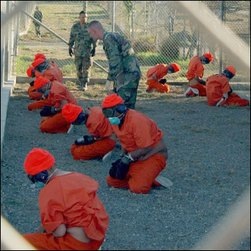
The Strange Case of Canada and Guantanamo Bay

3BF93F44-2E05-44F6-9FD2-187E31434EB3.jpg
When British citizen Moazzam Begg was released from the U.S. detention camp in Guantanamo Bay in 2005 after considerable protest by the UK government, I assumed that that would mark the beginning of the end of Guantanamo, or at least of citizens from nations allied with the U.S. being held there.

Nearly all "Western" nations have made some kind of protest about their citizens being held without recourse to due process in Guantanamo Bay, and some of them, including Denmark, Australia, Britain and Belgium have succeeded in efforts to have their citizens repatriated either to stand trial or to be released in their native country.

But Canada is the exception. Of the two Canadian nationals held at Guantanamo, Abdurrahman Khadr agreed to spy for the CIA in exchange for his release, while his brother Omar Khadr, who was just 15 at the time of his capture during a battle where he allegedly fought with Taleban forces against the invading U.S. troops, remains in custody. Khadr apparently took two bullets in that battle and allegedly killed one U.S. soldier.

Even if these charges are proved, Khadr meets the definition of a child soldier and should be a candidate for rehabilitation, not held in indefinite custody without recourse to any judicial system, including basic human rights that have been guaranteed since the time of the magna carta.

The decision by Khadr's lawyers to release a videotape of Khadr being interrogated and begging for help (or death) should be applauded. Hopefully it will shame the Canadian government into doing something. But then it looks like most folks in Canada won't be holding their breath.


My mind can't help but contrast the treatment of Khadr and other Guantanamo detainees, who at the most are accused of killing a handful of people, with the treatment of the real war criminals - Bush, Cheyney, Rumsfeld and companies like Blackwater are punished only by their profits, and (one can hope) guilty consciences.

St. Augustine narrates the story of Alexander the Great asking a pirate in his custody what he means by seizing ships upon the seas. The pirate replies:

What do you mean by seizing the whole earth: but because I do it with a petty ship, I am called a robber, whilst you who do it with a great fleet are called emperor.

Thursday, May 1, 2008

May Day, Mandela & We Are All Terrorists

May first is celebrated all over the world as labor day except in the United States. This may be seem like another aspect of U.S. parochialism (like the fact that we still buy milk in gallons and measure distance in miles) except for one thing: the events behind May Day took place here in the United States. In 1886, immigrant workers all over the country were demanding better working conditions. Their chief demand was that the workday be shortened to eight hours. On May 3, police fired into a crowd of demonstrators in Chicago killing four and wounding many more. The following day, as police were harassing the stragglers at a meeting called to figure out a response to the police violence, an unknown demonstrator threw a bomb at the police line, killing one. The police fired into the crowd (gathered at Haymarket Square) and another worker was killed. Though the police could never determine who threw the bomb, five prominent labor activists were sentenced to death and four of them were hanged for the crime. Soon after, global outrage at the actions of the U.S. government inspired the celebration of May Day, a day of global solidarity with U.S. workers.

This story came into my head today as I read about Nelson Mandela being on a list of terrorists and possibly denied entry to the United States. Mandela, of course was a terrorist according to FW De Klerk and the administrators of apartheid before him, and according to Ronald Reagan who backed the apartheid regime to the hilt. But within a few years of Mandela being branded an un-reformable terrorist, he became the celebrated first Black South African head of state.

Without Mandela and the movement for which he was a spokesperson South Africa would still be an apartheid state. Without the workers who were murdered by the U.S. state in 1886 and their struggle, who knows if we would have eight hour days, weekends, let alone basic education and healthcare? Whatever gains working class and colonized people have made over the centuries have been made by those whom the state brands as terrorists.