Sorry for the lack of updates recently. Been busy with the whole fall of global capitalism thingy. For some glimpses at what we've been up to check here and here.
Recent developments are almost too overwhelming to even comment about. A couple of scattered thoughts:
1) The IMF needs to go. A new loan to Pakistan was approved today, and loans to Hungary and Ukraine have already gone through. The IMF is using this crisis to salvage its reputation and its balance sheet, when it is the institution that created the preconditions for the crisis in the first place. Here's a more detailed article that Sameer wrote on this subject.
2) Let's hope Obama's policies are more visionary than his choices for important economic advisors. Democracy Now had a good panel on this this morning. Basically, almost all of Obama's economic team are former Clinton-era officials who are as responsible for the current situation as anyone. Well anyone except Alan Greenspan, who's in a category of his own. The New York Times, which is normally pretty bad on all this, has a great editorial explaining the culpability of Geithner, Summers, Rubin and all the rest. Nate Silver, who proved himself to be a brilliant pollster this election cycle, has an article arguing that we shouldn't be too quick to judge Obama by his cabinet, as most of the decisions will be coming from the top down. Somehow I don't find that thought comforting, though the chart of policies Nate prepared for that article is helpful.
In general we need to push Obama and his team towards a new kind of economic policy, one that will set up institutions that are more transparent, more accountable and more democratic than what we have now. Ultimately the system should be one that prioritizes human need and basic human rights over the "right" to unlimited profit. This crisis presents all of us who would work for change the opportunity to make those changes real. The opportunity won't come again in most of our lifetimes (the last time was in the 1930s and 40s), so we'd better make the most of it for ourselves and for the next generation.
Showing posts with label globalization. Show all posts
Showing posts with label globalization. Show all posts
Tuesday, November 25, 2008

Monday, October 20, 2008
Friedman v. Keynes Part I: "How Dare They Expect Us Not to be Greedy - I mean that's the point right?"
Today's news that Ben Bernanke is now advocating serious government spending in order to help stay the huge downturn in the markets should not surprise anyone. Those who have studied economic history will know that "pure" capitalism has really only been tried once or twice - often with disastrous results.
When I heard that Lehman and AIG were going under (or being nationalized in the case of AIG) I knew that the era of Milton Friedman was at an end. Unregulated markets designed to maximize short-term profit above all else always collapse under their own weight. As a friend at one of the last remaining investment banks so eloquently put it, "It's the government's own damn fault anyway for not expecting the free market to be greedy - I mean, that's the point, right?"
But unchecked greed will get even the greedy into trouble. As this graph shows, it wasn't in the interest of these bankers to effectively lose as much money as they've gained since 2004.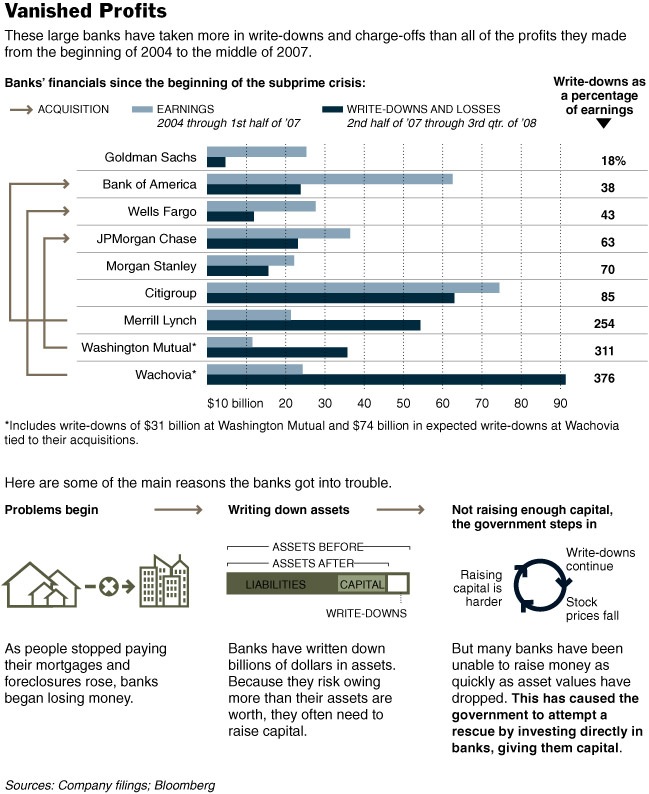
(We should all be outraged that a few CEOs and managers have been rewarded to the tune of millions of dollars for losing as much money as they made. Bailout using tax payer dollars while not going after these ill-gotten gains is effectively a subsidy from the poor to the rich. But I digress.)
After the demise of the current system, we're back where we were circa 1960, i.e. Keynesian economics. John Maynard Keynes was a well-regarded economist who developed much of what we now know as the discipline of economics, including the entire discipline of macroeconomics. Keynesian economics argues that the state can play a role - sometimes a major role - in building up the private sector and in stimulating economic growth.
After the depression, World War II and the Bretton Woods Conference (for more on that check out this brilliant essay) Keynesian economics ruled the day, heralding a period of relative growth and prosperity in the United States and around the world. (The success of anti-colonial movements in Africa and Asia no doubt had something to do with these growth rates as well.) As the world switched (with the help of organizations like the International Monetary Fund) to Friedmanism in the 1980s, the effects were disastrous even in terms of economic indicators like growth rates and wages - let alone poverty indicators such as deaths by hunger and preventable disease.
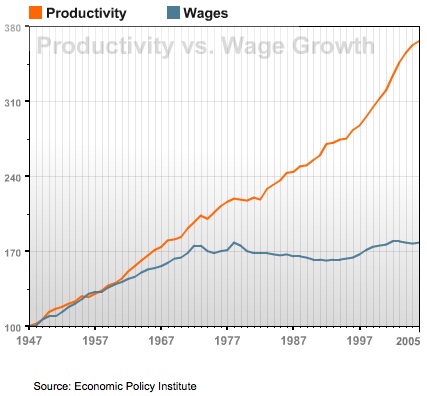
But the system did work well for a few. While worries about inflation were effectively used to undermine wage growth, CEO salaries were allowed to skyrocket. Cutting taxes on capital gains and other kinds of income gave us one of the most regressive tax systems in the world, meaning you tax poor people at higher rates than you tax rich people. A government survey that came out in August showed that most corporations - including very large and profitable corporations - effectively pay no taxes at all.
What brought the system down was not public anger at the injustice of it all, it was that the system could not self regulate even in its own interest. The shock has been so bad that it's there's no chance of reestablishing that regulation - rather we must go back to an explicitly state-driven (as opposed to merely a state-regulated) form of capitalism.
Today's news confirms that Friedmanism is dead both in the U.S. and around the world, and that there's no going back. The obvious question remains: Is that a good thing for those of us who care about ending the violence of poverty and establishing a more just and democratic economic system where human need is prioritized over corporate greed?
When I heard that Lehman and AIG were going under (or being nationalized in the case of AIG) I knew that the era of Milton Friedman was at an end. Unregulated markets designed to maximize short-term profit above all else always collapse under their own weight. As a friend at one of the last remaining investment banks so eloquently put it, "It's the government's own damn fault anyway for not expecting the free market to be greedy - I mean, that's the point, right?"
But unchecked greed will get even the greedy into trouble. As this graph shows, it wasn't in the interest of these bankers to effectively lose as much money as they've gained since 2004.
(We should all be outraged that a few CEOs and managers have been rewarded to the tune of millions of dollars for losing as much money as they made. Bailout using tax payer dollars while not going after these ill-gotten gains is effectively a subsidy from the poor to the rich. But I digress.)
After the demise of the current system, we're back where we were circa 1960, i.e. Keynesian economics. John Maynard Keynes was a well-regarded economist who developed much of what we now know as the discipline of economics, including the entire discipline of macroeconomics. Keynesian economics argues that the state can play a role - sometimes a major role - in building up the private sector and in stimulating economic growth.
After the depression, World War II and the Bretton Woods Conference (for more on that check out this brilliant essay) Keynesian economics ruled the day, heralding a period of relative growth and prosperity in the United States and around the world. (The success of anti-colonial movements in Africa and Asia no doubt had something to do with these growth rates as well.) As the world switched (with the help of organizations like the International Monetary Fund) to Friedmanism in the 1980s, the effects were disastrous even in terms of economic indicators like growth rates and wages - let alone poverty indicators such as deaths by hunger and preventable disease.
But the system did work well for a few. While worries about inflation were effectively used to undermine wage growth, CEO salaries were allowed to skyrocket. Cutting taxes on capital gains and other kinds of income gave us one of the most regressive tax systems in the world, meaning you tax poor people at higher rates than you tax rich people. A government survey that came out in August showed that most corporations - including very large and profitable corporations - effectively pay no taxes at all.
What brought the system down was not public anger at the injustice of it all, it was that the system could not self regulate even in its own interest. The shock has been so bad that it's there's no chance of reestablishing that regulation - rather we must go back to an explicitly state-driven (as opposed to merely a state-regulated) form of capitalism.
Today's news confirms that Friedmanism is dead both in the U.S. and around the world, and that there's no going back. The obvious question remains: Is that a good thing for those of us who care about ending the violence of poverty and establishing a more just and democratic economic system where human need is prioritized over corporate greed?
Monday, September 15, 2008
On today's further unraveling of the mortgage bubble
I share with you a quote and a cartoon. First the cartoon:
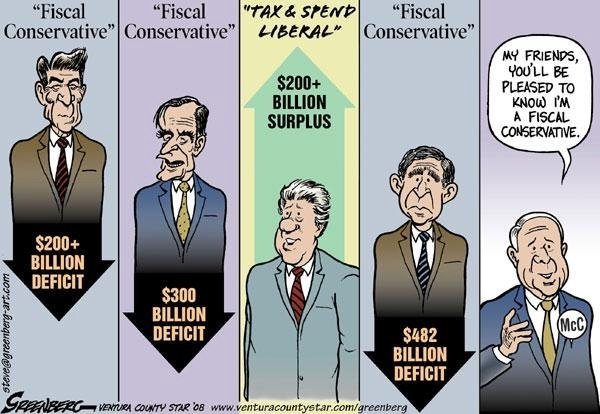
I really don't get how the Republican party can claim to be the party of fiscal responsibility and no one calls them on it. Especially with a $7.7 trillion war going on.
And the quote:
Modern industrial civilization has developed within a certain system of convenient myths. The driving force of our industrial civilization has been individual material gain, which is accepted as legitimate, even praiseworthy on the grounds that private vices yield public benefits, in the classic formulation. Now it's long been understood, very well, that a society that is based on this principle will destroy itself in time. It can only persist with whatever suffering and injustice it entails, as long as it's possible to pretend that the destructive forces that humans create are limited, that the world is an infinite resource, and that the world is an infinite garbage can.
At this stage of history, either one of two things is possible: either the general population will take control of its own destiny and will concern itself with community interests, guided by values of solidarity, and sympathy and concern for others; or alternatively, there will be no destiny for anyone to control.
-Noam Chomsky from Manufacturing Consent
I think the entire financial industry as its been built up over time and especially since about 1990 when we've had these huge speculative bubbles is a way for us to avoid facing the music: if we continue to prioritize private profit over public goods, we will be destroying ourselves as a species.
I really don't get how the Republican party can claim to be the party of fiscal responsibility and no one calls them on it. Especially with a $7.7 trillion war going on.
And the quote:
Modern industrial civilization has developed within a certain system of convenient myths. The driving force of our industrial civilization has been individual material gain, which is accepted as legitimate, even praiseworthy on the grounds that private vices yield public benefits, in the classic formulation. Now it's long been understood, very well, that a society that is based on this principle will destroy itself in time. It can only persist with whatever suffering and injustice it entails, as long as it's possible to pretend that the destructive forces that humans create are limited, that the world is an infinite resource, and that the world is an infinite garbage can.
At this stage of history, either one of two things is possible: either the general population will take control of its own destiny and will concern itself with community interests, guided by values of solidarity, and sympathy and concern for others; or alternatively, there will be no destiny for anyone to control.
-Noam Chomsky from Manufacturing Consent
I think the entire financial industry as its been built up over time and especially since about 1990 when we've had these huge speculative bubbles is a way for us to avoid facing the music: if we continue to prioritize private profit over public goods, we will be destroying ourselves as a species.
Monday, August 11, 2008
The Dawning of a New Era
And it's not a pretty one...
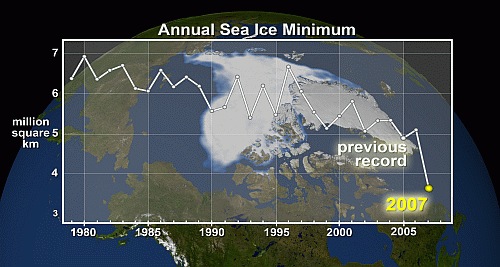
This article by Mike Davis points out that the London Society, one of the world's leading scientific bodies, now believes that the earth has entered a new epoch. The "Anthropocene" era is differentiated from the last not in geological terms but in terms of human intervention.
In a report published by the Geological Society America [pdf]:
The implications of this are mind-boggling and Davis does a pretty good job of going over some of the more obvious ones. Some of his best points:
1) The private sector is not the solution (investment in alternative technologies is at the moment largely state driven, despite the propaganda coming in the form of TV ads from Exxon-Mobil, BP, Shell and Chevron).
2) Carbon trading is not the solution (there's every possibility that even if the Kyoto treaty and other Carbon trading mechanisms were actually in place, there would be minimal change to net global carbon emissions, which is what really matters if we're worried about the global ecosystem).
3) Developed countries have collectively done more damage (and should take more responsibility) than developing countries for the damage done. Countries in the global south till date are still much smaller per capita carbon emitters than the U.S. or Europe. Furthermore they have built their development models - especially during the colonial period but even till date - on the extraction of resources from the Global South, and therefore there is an ecological debt that the North owes the South.
Again, definitely worth a read.
Far less educational but on the humorous side of things is this spoof of Bush's climate denial done by Saturday Night Live featuring Will Ferrell as W. Talking about "the global warmings".
This article by Mike Davis points out that the London Society, one of the world's leading scientific bodies, now believes that the earth has entered a new epoch. The "Anthropocene" era is differentiated from the last not in geological terms but in terms of human intervention.
In a report published by the Geological Society America [pdf]:
The combination of extinctions, global species migrations, and the widespread replacement of natural vegetation with agricultural monocultures is producing a distinctive contemporary biostratigraphic signal. These effects are permanent, as future evolution will take place from surviving (and frequently anthropogenically relocated) stocks.
The implications of this are mind-boggling and Davis does a pretty good job of going over some of the more obvious ones. Some of his best points:
1) The private sector is not the solution (investment in alternative technologies is at the moment largely state driven, despite the propaganda coming in the form of TV ads from Exxon-Mobil, BP, Shell and Chevron).
2) Carbon trading is not the solution (there's every possibility that even if the Kyoto treaty and other Carbon trading mechanisms were actually in place, there would be minimal change to net global carbon emissions, which is what really matters if we're worried about the global ecosystem).
3) Developed countries have collectively done more damage (and should take more responsibility) than developing countries for the damage done. Countries in the global south till date are still much smaller per capita carbon emitters than the U.S. or Europe. Furthermore they have built their development models - especially during the colonial period but even till date - on the extraction of resources from the Global South, and therefore there is an ecological debt that the North owes the South.
Again, definitely worth a read.
Far less educational but on the humorous side of things is this spoof of Bush's climate denial done by Saturday Night Live featuring Will Ferrell as W. Talking about "the global warmings".
Tuesday, August 5, 2008
The End of the Doha "Development" Round
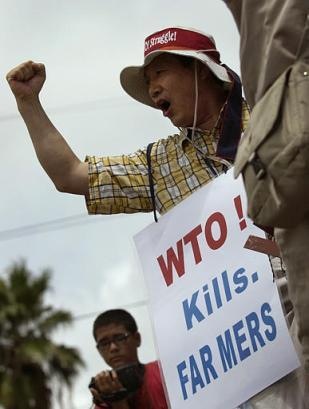
Last week saw what we all hope may be the final curtain falling on the drama of the Doha "development" round of World Trade Organization negotiations. I put the word development in quotes because it's been obvious to those of us who have been following this from the start that the Doha round has nothing to do with development.
The shocking thing about last week's developments is not the fact that the U.S. and other developed nations were not able to push through their agenda - with elections in the U.S. and India coming up, that outcome was the odds on favorite. The shocking thing is how few people - including many mainstream economists see this as a bad thing.
In this article, economist Dani Roderik argues that the breakdown in consensus among those who touted free trade as the solution to all things may indicate the end of the globalization project as we know it.
Though all of them are content to see Doha's failure, these economists diverge in their rationale as to why that failure may not be a bad thing.
So we have Paul Samuelson, the author of the postwar era's landmark economics textbook, reminding his fellow economists that China's gains in globalization may well come at the expense of the United States; Paul Krugman, today's foremost international trade theorist, arguing that trade with low-income countries is no longer too small to have an effect on inequality; Alan Blinder, a former U.S. Federal Reserve vice chairman, worrying that international outsourcing will cause unprecedented dislocations for the US labor force; Martin Wolf, the Financial Times columnist and one of the most articulate advocates of globalization, writing of his disappointment with how financial globalization has turned out; and Larry Summers, the U.S. Treasury chief and the Clinton administration's "Mr. Globalization," musing about the dangers of a race to the bottom in national regulations and the need for international labor standards.
For me the striking thing is that most of these arguments - including those about the dangers of outsourcing, the dangers of rampant speculation caused by fiscal liberalization, and the race to the bottom - were articulated by social movements around the world from the moment the WTO came into existence in 1995.
So has history proven us right or have economists suddenly started paying attention to the facts? I think neither. For the first time since the fall of the Soviet Union, the U.S. is feeling threatened in its position of the sole global super power. China, India, and Asia as a whole represent a counter-balance of sorts, and these economies look a lot stronger than that of the U.S. which is plagued by a housing crisis, a weak dollar, and overextension in Iraq, Afghanistan and elsewhere. When the U.S. is not always able to dictate the rules in its own favor, protectionism may not be such a bad thing after all...
For more on trade, protectionism and development, be sure to check out Ha-Joon Chang's Bad Samaritans: The Myth of Free Trade and the Secret History of Capitalism.
And here's a short video on what's wrong with the current round of failed negotiations from our friends in the Philippines.
Monday, July 21, 2008
Trade Policies and King Leopold's Ghost
I was in Belgium earlier this year for some meetings at the European Parliament on trade between Africa and Europe. Those meetings were all about the so-called "Global Europe" program, which is code name for the European Commission's international trade strategy. (Global Europe is part of the failed EU constitution attempts and the more recent Lisbon Treaty, which might also be a failure.)
When we met with MEPs (members of the European Parliament), those who supported the Lisbon Treaty and the Global Europe proposals were quite happy to concede that this was all about increased access to the resources and markets of developing countries. They claimed that as the U.S. was already pursuing such a strategy in Africa, and China seemed to be poised to do the same, they had little choice other than to use African resources and consumers for the benefit of European corporations.
What's left unsaid is that this is not a new strategy for Europe; in fact it is a very old strategy.
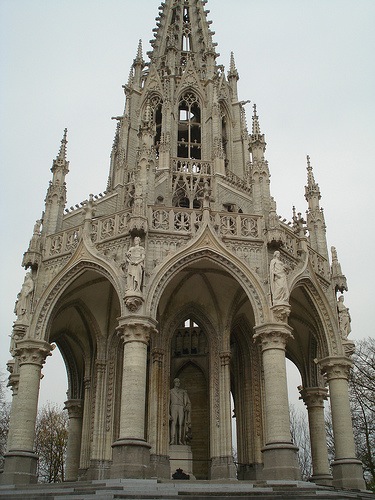
When I saw some of the monuments in Belgium, one of the most famous of which is the castle at Laeken pictured above, I could not help but think of a book I had read some years ago. As I reread the book - King Leopold's Ghost, by Adam Hochschild - over the past few weeks, I began to understand this castle and much of Europe's splendor would not have been possible without the brutality of European colonialism in Africa.
King Leopld II was the King of Belgium from 1868 until his death in 1909. While turn-of-the-century Europe was moving towards a parliamentary democracy system with Kings as figureheads rather than purveyors of political power, Leopold established a mediaeval kingdom in the heart of the tropical African jungle. Its purpose? To extract African natural resources (in this case wild rubber) for the profit of European corporations and the Belgian King. The Africans "employed" to harvest the wild labor were subject to kidnappings, forced labor, whippings using a deadly hippopotamus hide instrument called the chicote and murder. Soldiers were punished for using bullets for anything other than killing, so for every bullet spent they were encouraged to bring back a human hand to their captain. By most estimates, the toll of murder, disease, famine, and reduced birth rates cost the Congo some 10 million lives during Leopold's rule.
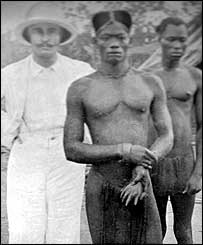
Leopold used the fruits of this system to build buildings in Laeken, Brussels, and elsewhere in Europe, to buy property on the French Riviera, and to keep his young mistress in the fancy silks that she preferred. When court battles after his death divided up his huge fortune between his daughters and the Belgian state, the option of returning the ill-gotten gains to the people of the Congo was not considered.
While the brutality of the Belgian Congo is not worse or better than the brutality of the French, Portugese, Dutch or English colonizers in Southern and Central Africa, there are a couple of things that stand out about this story. The first is that so few people - even in the countries involved - know about it. Stories of the rubber terror do exist in some oral traditions of some of peoples of the Congo, but for the middle and upper classes who receive their education in Kinshasa or in other cities, the Belgians are still portrayed as those who brought civilization to Central Africa. In Belgium, my references to King Leopold's Congo were usually met by completely blank stares.
The second is that by virtue of its other riches and continued European and American exploitation of those riches, the Democratic Republic of the Congo (as the former Belgian Congo is known today) is still a disaster area. At the end of the colonial period, anti-colonial elements galvanized around Patrice Lumumba, a charismatic leader who believed in African economic as well as political independence and was greatly influenced by the All-African Peoples' Conference in Accra, Ghana. CIA operations chief Richard Bissell saw Lumumba as a "mad dog", and paid mercenaries to assassinate him in 1961, about a year after he had taken office as the country's first Prime Minister. The U.S. went on to prop up the military dictatorship of Mobutu Sese Seko, a man whose habits of giving away lucrative mining contracts to whoever would pay the biggest bribe and treating the country's finances as his own bank account resembled those of Leopold II nearly a century before.
If one really wants to understand the brutality of the global economic system - either the colonial economic system or the system that has replaced it - one need look no further than the Congo. Here's a short video that touches on Leopold's rule but is primarily about Lumumba...
Wednesday, July 2, 2008
Food Crises in Africa and Beyond
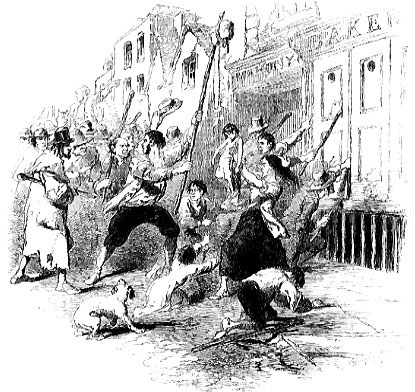
The sad thing of course is that this is certainly a preventable - and I would argue a planned - crisis. As I argue in this piece largely about Africa, the IMF and the World Bank have taken dangerous steps to privatize and deregulate the global food industry. While marginalized populations around the world are struggling to make ends meet, Archer Daniels Midland and other agribusiness conglomerates are posting record profits. The deregulation was done in their interest and they are now reaping the benefits, while mostly urban impoverished populations unable to afford increased food prices are the hardest hit.
But the deregulation alone does not explain the crisis. As I argue here, it can hardly be a coincidence that the huge rise in food prices is occurring at almost exactly the same time as the U.S. mortgage market is crashing. It's as if there is too much speculative capital in the world, and wherever it goes it is likely to cause overvaluations of different kinds.
Theoretically speaking, there should be no cause for despair. All of these problems have solutions, some of them fairly intuitive. Farmers have been providing the world with food since the Bronze age. It may be a good idea to trust their instincts, to allow them to grow what makes sense in their national and regional environments, and for governments to worry first about feeding their own citizens and then exporting luxury goods. Speculation can be easily curbed through some kind of taxation, like the tax proposed by economist James Tobin; often a fraction of a per cent tax imposed on every transaction may be enough to dramatically decrease speculator's profit margins.
But these are common sense solutions. Someone let me know when the people who make decisions develop some common sense.
For more background reading and resources check out La Via Campesina and Food First.

Wednesday, April 30, 2008
Don't Let Your Food Do Drugs
 In an infuriating but completely predictable narrative, many of the world's leading publications have begun advocating the increased use of technology to solve the world's food problems.
AARRGGH!!! At a time when critiques of bad-for-you and unsustainable farming practices seemed to be going mainstream (just look at the popularity of Polan's Omnivore's Dilemma or the recent movie King Corn), it looks like the global food industry has revived the narrative that their big business money making is the only way to feed the world. I've written an article on what's wrong with the Gates-Rockefeller push for a "new green revolution" is a really bad idea; it should be published by Food and Water Watch in the next couple of weeks. Till then, check out this really great backrounder by Food First and this older article over a Grist.
Friday, April 25, 2008
Hunger and History in Haiti
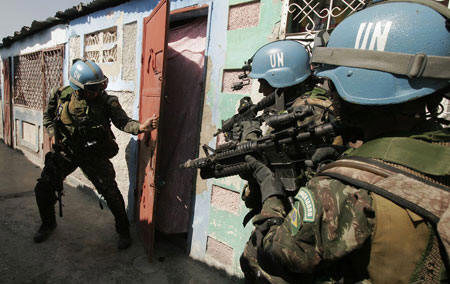
There is perhaps no case more disturbing in the global economy than that of Haiti. Today's Miami Herald has a story on donors attempting to come to Haiti's aid in the midst of violence (and the threat of much more violence) due to rising food prices.
Haiti is the poorest country in the western hemisphere, but it was the jewel of the French colonial crown. The primary reason for its ongoing poverty is the unending desire on the part of the "civilized" world to extract vengeance for Haiti's defeat of the French in 1804, making it the second oldest republic in the Americas. The best book for understaning this story is Adam Hachschild's Bury the Chains which is a remarkable account of the end of the transatlantic slave trade and one of my all time favorites.
The Miami Herald article also mentions the role of the World Bank and the IMF:
In November 2006, Haiti signed a multi-year program with the IMF that would culminate with a pardon of nearly $1 billion of the $1.6 billion the country owes multilateral institutions like the Inter-American Development Bank (IDB) and the World Bank
That program, HIPC (the Heavily Indebted Poor Countries program), would lock in the liberalization policies that have been such a disaster for Haiti. While debt cancellation is a good thing, tying it to these conditions is ludicrous, especially in a country that has been as colonized as collectively punished as Haiti.
Today that colonization goes on in the form of a UN occupation. For more on economic and political justice and to find out how to get involved, check out the Quixote center's Haiti Reborn project.
Thursday, April 24, 2008
Thomas Friedman gets pied
From ZP Heller blogging at alternet...
I'll try to post a longer critique of Friedman at some point. He's my favourite straw man to bring up in workshops these days because his arguments in favour of globalization vary between the silly and the inane.
Thomas Friedman, the author and NY Times columnist, was all set to deliver an Earth Day speech at Brown University entitled "Green is the new Red, White, and Blue." Friedman's been calling for government-led environmentalism to bring about energy salvation and climate change.
Not everyone agrees with Friedman's ideas, including the Greenwash Guerrillas, who stormed the stage and let their green pies fly. As the Greenwash Guerillas fled, they threw leaflets into the crowd that stated:
Thomas Friedman deserves a pie in the face...
* Because of his sickeningly cheery applaud for free market capitalism's conquest of the planet.
* For telling the world that the free market and techno fixes can save us from climate change. From carbon trading to biofuels, these distractions are dangerous in and of themselves, while encouraging inaction with respect to the true problems at hand.
* For helping turn environmentalism into a fake plastic consumer product for the privileged
* For his long-standing support for the US Occupation of Iraq and the Israeli occupation of Palestine. Such committed support to the US War Machine and its proxy states overseas cannot be masked behind any twisted mask of "green" - the US Military is the largest single emitter of greenhouse gases in the world.
* For his pure arrogance.
On behalf of the earth and all true environmentalists -- we, the Greenwash Guerrillas, declare Thomas Friedman's "Green" as fake and toxic to human and planetary health as the cool-whip covering his face.
I'll try to post a longer critique of Friedman at some point. He's my favourite straw man to bring up in workshops these days because his arguments in favour of globalization vary between the silly and the inane.
Friday, April 4, 2008
Edward Said on Iraq
Apologies for the lack of activity in this space. We have updates on our recent travels to Thailand and Arizona, as well as work on proscenium and street theater, but before we get to those, this 2001 video of Edward Said taking on Charlie Rose and debunking the status quo on Iraq (and the rest of the Middle East) is definitely worth watching. The second interview is with George Soros, and while he's a bit of a mixed bag (defintely not the kind of champion that Said was) his take on market fundamentalism and the "open society" also deserves some attention.
Enjoy!
Enjoy!
Sunday, January 27, 2008
Visit to Al-Jazeera
This week I had the opportunity to do my first interview with Al-Jazeera English. While visiting their DC studio, I also got the opportunity to look around and check out their live feed, a rare luxury for those of us in the U.S., where the government has blocked Al-Jazeera from negotiating a deal with any cable or satellite providers. Amazing stuff. Kind of like the BBC with a Global South focus. In the half hour or so I spent waiting for my interview to start, I saw clips from Kenya, Palestine, Pakistan, a focus group on African development. I thought it was pretty impressive.
Anyway, here are the clips of the show I was on, called inside story. If you have time, you may want to check out Al-Jazeera's youtube channel. You can also get a premium subscription from their website which apparently lets you check out their archives in better quality, but I haven't checked that out as yet.
Anyway, here are the clips of the show I was on, called inside story. If you have time, you may want to check out Al-Jazeera's youtube channel. You can also get a premium subscription from their website which apparently lets you check out their archives in better quality, but I haven't checked that out as yet.
Blogged with Flock
Subscribe to:
Posts (Atom)